
Modern passenger vehicles and heavy commercial trucks use ultra-high-strength boron steel in their A- and B-pillars, sills and door beams. Equipping a rescue tender for fast, safe extrication requires matching each stage of the operation with the right tool from a coordinated 72 MPa system.
Step 1: Vehicle Stabilization & Lifting
Before any hydraulic blade touches the vehicle, the chassis must be immobilized so movement does not injure the casualty:
- Rubber Chocks & Cribbing Blocks: Wedge under wheels and sills within seconds.
- Rescue Struts Set XTZX-01: Pneumatic struts (600–2,608 mm) and hydraulic shoring struts stabilize vehicles on their side or roof.
- Air Lifting Bags (6 t / 10 t / 22 t): Lift heavy trucks or buses from narrow ground clearances using a 6.8 L air cylinder.
Step 2: Glass Management & Initial Access
- Glass Breaker & Cutter Sets XTBLQ-01 / XTBLQ-02JD: Remove tempered side glass and cut laminated windshields cleanly.
- Edge Guard Kit: Magnetic PVC protective covers placed over cut pillars to shield rescuers and patients from sharp steel edges.
Step 3: Door Popping, Pillar Cutting & Dashboard Roll
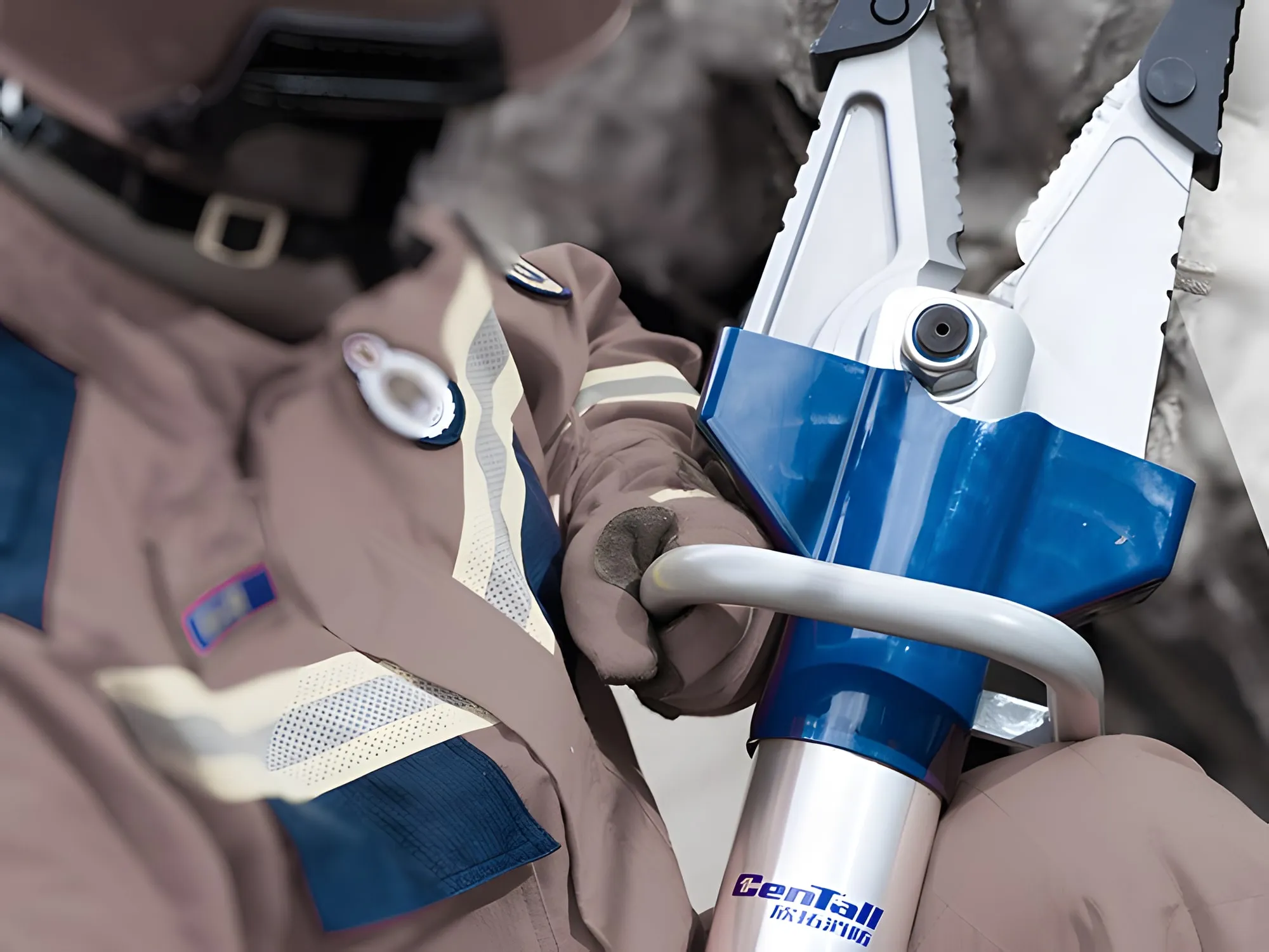
- Spreading (730 mm opening): The Hydraulic Spreader SP-311 / SP-730 (up to 247 kN max spreading force) or Amphibious Spreader SP-730 E2 pops jammed doors and separates crushed fenders.
- Pillar Cutting (up to 1,280 kN): Choose the S-313 Eagle-Beak Cutter (325 mm opening) for wide pillars, or the S-512 Heavy Cutter (1,280 kN cutting force, Φ40 mm round bar capacity) for reinforced columns.
- Dashboard Push & Space Creation: A Two-Stage Telescopic Ram R-420 / R-450 packs a short closed length (480–525 mm) to fit inside compact footwells while extending up to 749 mm.
All CenTall extrication tools can be supplied as customized sets with matching couplings. Send us your tender requirements for a complete quotation.